Luxury Property Market in Cyprus: Premium Developments and Pricing
The luxury property Cyprus market has matured into a sophisticated, internationally visible segment over the past two decades. Investors, second-home buyers, and lifestyle seekers arrive with clarity about what they want: privacy, modern design, and proven returns. The island’s political stability, favourable tax framework, and strategic location at the junction of Europe, Asia and Africa have catalysed demand for higher-tier assets, creating a layered market with clear submarkets and diverse product types.
For buyers who consider residency or citizenship options alongside real estate, there is a practical overlap between property choice and immigration pathways; resources describing how to get a Cyprus passport can be part of the decision matrix when evaluating price, developer credentials, and legal compliance. This convergence of lifestyle and pragmatic planning is one reason the Cyprus luxury market continues to attract cross-border capital and second-home purchasers.
Luxury demand in Cyprus is driven by lifestyle, investment logic, and legal frameworks that reward well-structured purchases.
Macro Drivers Shaping Premium Real Estate Cyprus
Understanding premium real estate Cyprus requires a macro view that links global capital flows, regional geopolitics, and local policy. High-net-worth individuals seek jurisdictions that combine reputable governance, clear property rights, and accessible amenities. Cyprus offers these characteristics with the added advantage of comparatively lower operational costs and strong connectivity to European markets. Those overarching conditions have defined the course of the market since the early 2000s and continue to influence developer strategy and pricing.
Currency stability, EU membership, and a legal system derived from common law attract buyers from multiple regions: Russia, the Middle East, China, and Western Europe. The island’s tax treaties and non-domicile regimes further influence where wealth chooses to sit. As a consequence, demand patterns in the luxury segment reflect not only local supply but global wealth distribution shifts and the emergence of new capital centers.
Macro fundamentals—EU membership, legal stability, and tax positioning—make Cyprus a repeat destination for premium buyers.
Economic Context and Capital Flows
Economic cycles matter more for the high-end property Cyprus segment than casual observers assume, but their effects are nuanced. Unlike mass-market housing, luxury real estate responds to discretionary capital availability, currency hedging strategies, and tax planning. During equity market expansions, capital shifts into second homes and trophy assets; during contractions, the segment shows selective resilience where assets can be repossessed or restructured without significant price collapses.
On the supply side, Cyprus has seen a calibrated release of projects: developers present fewer units but with higher specifications, reducing the risk of oversupply in top-tier categories. This strategic restraint helps preserve valuation across prime locations and ensures that the cyprus luxury market remains attractive for long-term buyers and institutional investors.
Regulatory Climate and Legal Assurance
Legal clarity directly reduces transaction risk for international buyers. Land titles, building permits, and planning approvals are central to the confidence premium buyers place in developers. Cyprus follows transparent land registry procedures and has modernised aspects of its construction permitting, though attention to due diligence remains essential. Lawyers and independent surveyors are part of every transaction to confirm compliance and protect buyer interests.
Regulatory incentives, such as gradual tax reforms and property-related concessions, often influence the structure of deals—whether sellers include furniture packages, maintenance agreements, or rental management contracts. These elements matter because experienced buyers compare total cost of ownership and expected net yields across jurisdictions before committing capital.
Product Types: What Counts as High-End Property Cyprus?
High-end property Cyprus is not a single homogeneous category; it includes a range of product types that appeal to different buyer profiles. Typically, the market segments into beachfront villas, branded residences, penthouse apartments in urban centres, private island-style estates, and exclusive gated communities that emphasise privacy and amenities. Each product type satisfies a distinct demand vector—liquidity, lifestyle, rental yield, or status.
Developers position projects along a spectrum of exclusivity. Some prioritise experiential elements—private beaches, spa facilities, marina access—while others emphasise architectural pedigree, sustainability credentials, or technology integrations that justify premium pricing. Buyers weighing options must assess not only headline price but ancillary services and governance structures that preserve value.
High-end properties in Cyprus differentiate themselves by product type: beachfront, branded, penthouses, private estates, and wellness communities.
Beachfront Villas and Coastal Estates
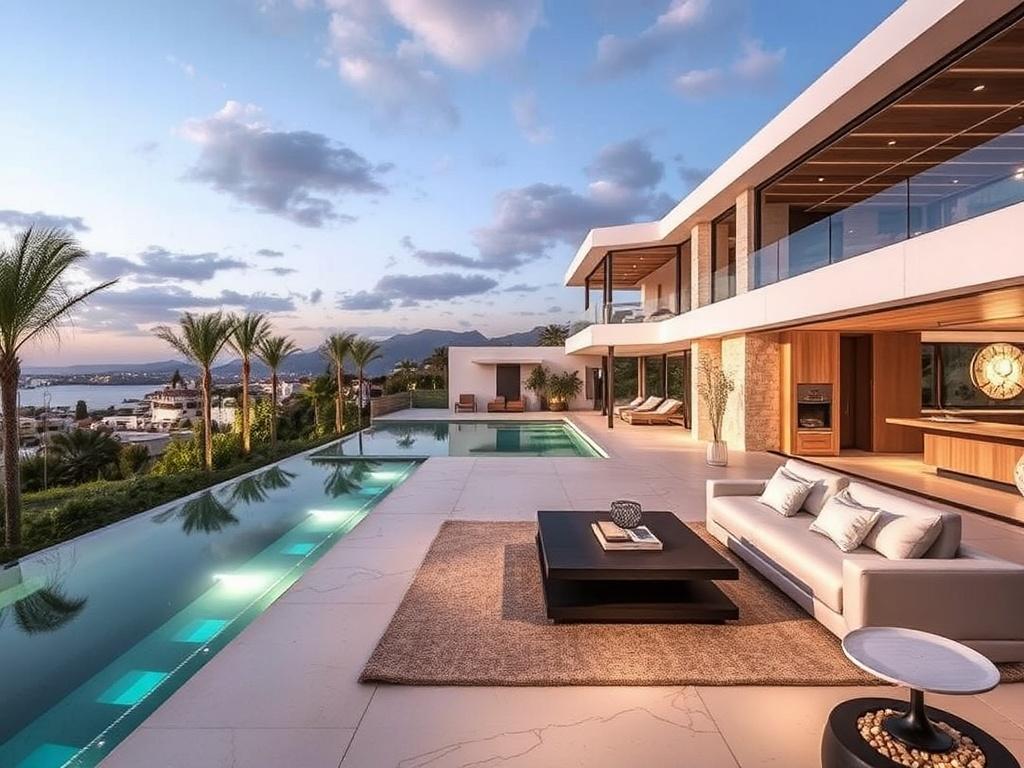
Beachfront homes command a price premium because of scarcity and ongoing demand for direct sea access. In Cyprus, coastal zoning protections and environmental regulations limit the development of new direct-sea plots in many areas, increasing the scarcity value of existing beachfront holdings. Buyers pay for uninterrupted views, immediate water access, and the social cachet of a coastal address.
These properties often feature investment-grade specifications: high ceilings, integrated home technology, private pools, and professionally designed outdoor spaces. Maintenance obligations and coastal erosion considerations are evaluated in pre-purchase diligence, but the cachet and rental income potential make them core offerings in the luxury developments Cyprus pipeline.
Branded Residences and Hotel-Linked Units
Branded residences—projects attached to an international hospitality name—have proliferated in Cyprus, appealing to buyers who desire standardised service levels and potential rental networks. These units often exist within mixed-use developments combining private residential floors with managed hospitality wings. Brand affiliation can shorten marketing cycles and provide predictable operating models for owners who rent their units seasonally.
For investors focused on yield, branded products present both benefits and trade-offs: higher service fees are balanced against potentially superior occupancy and higher nightly rates when the unit is placed on the market. The structure of the management agreement is essential, and legal review of exit conditions and brand obligations is standard practice.
Urban Penthouses and High-Rise Luxury
Urban luxury in cities such as Limassol and Nicosia centres on penthouses and apartments that promise proximity to business centres, marinas, and cultural amenities. These units appeal to professionals, corporate relocations, and those who prefer lower-maintenance properties. High-rise projects also deliver boutique on-site services—concierge, fitness, secure parking—and benefit from economies of scale in building management.
While penthouses do not offer the outdoor space of villas, smart design and access to rooftop amenities create alternative value propositions. Architectural distinctiveness and interior finishes can command significant price per square metre premiums in the cyprus luxury market.
Primary Locations: Where Expensive Property Cyprus Concentrates
The distribution of expensive property Cyprus is not uniform. Location remains the primary determinant of price and liquidity, but within the island there are clear clusters that define your investment thesis. Limassol, Paphos, Ayia Napa, Larnaca and parts of the Mesaoria plain each offer unique value drivers, from business hubs to resort desirability. Understanding these clusters clarifies market segmentation and investment potential.
Limassol has matured into a cosmopolitan centre with a strong maritime economy and a concentration of luxury apartment towers and waterfront villas. Paphos offers heritage and amenity-led living with a significant residential market for golf and retirement buyers. Ayia Napa and the broader Famagusta coastline are entertainment and resort-oriented, attracting seasonal premium rentals and lifestyle investors.
Geography defines pricing—coastal access and urban amenities create the most liquidity in the Cyprus luxury market.
Limassol: The Financial and Marina Hub
Limassol is the island’s commercial engine, where international business, shipping registries, and high-end retail converge. The marina district, in particular, has attracted branded developments and luxury towers that offer buyers both lifestyle perks and proximity to corporate services. It is common to see mixed portfolios among buyers here—city apartments for convenience paired with a coastal villa elsewhere.
Pricing patterns in Limassol show a premium per square metre in waterfront projects and newer towers that have a strong management proposition. The secondary market is active, with resales influenced by the relative scarcity of new prime plots and the continuing appeal of marina-linked addresses.
Paphos: Heritage, Golf, and Long-Term Lifestyle Appeal
Paphos presents a different profile: it appeals to buyers who prioritise cultural richness, golf facilities, and a more relaxed pace of life. The area around the port and near established golf courses has seen high-quality villa developments and gated communities tailored to long-term residents and retirees. These projects often focus on privacy, landscaped communal spaces, and continuity in build quality.
While Paphos may not match Limassol for corporate demand, it offers steady, high-quality rental demand seasonally and retains strong capital preservation qualities due to desirable long-term occupancy patterns.
Ayia Napa, Protaras, and the Eastern Coast
The eastern coast is unmistakably resort-oriented. Ayia Napa and nearby Protaras attract younger holidaymakers and families; as a result, high-quality holiday homes and upscale resort complexes dominate new supply. Developers often design for rental optimisation, providing owners with flexible management packages to capture high seasonal yields.
These coastal resorts also diversify the Cyprus luxury market by blending entertainment and family-friendly offerings, and they attract buyers who want both lifestyle and income generation potential during peak seasons.
Pricing Structure and Typical Valuations
Pricing in the luxury property Cyprus sector varies significantly by location, product type, finish level and developer reputation. However, consistent patterns emerge: sea-front properties and projects linked to international brands command the highest per-square-metre rates; premium urban projects follow closely, and inland high-spec villas and gated communities generally sit lower on a per-square-metre basis but offer larger land parcels and privacy.
Understanding the pricing laws requires a granular approach—comparing price per square metre, net yield expectations, and all-in ownership costs including service charges, taxes, and maintenance. The market is buyer-aware and expects transparency from agents and developers; conversely, buyers must bring disciplined comparative analysis to each opportunity.
Price is a function of location, build quality, brand association, and recurring ownership costs—never a single absolute.
Representative Price Table
The table below outlines indicative price bands for primary segments and regions. These are directional and should be validated with up-to-date local valuations before committing to purchase.
| Location / Product | Typical Price Range (EUR) | Average Price per m² (EUR) |
|---|---|---|
| Limassol Marina Penthouses | €1,200,000 – €8,000,000 | €5,000 – €12,000 |
| Beachfront Villas (various coasts) | €2,000,000 – €25,000,000 | €4,000 – €10,000+ |
| Paphos Golf Estates | €800,000 – €5,000,000 | €2,000 – €5,000 |
| Ayia Napa Resort Apartments (Luxury) | €450,000 – €3,000,000 | €2,500 – €6,000 |
| Branded Residences (Island-wide) | €900,000 – €10,000,000+ | €3,500 – €11,000 |
Interpreting Price Metrics
Price per square metre is a useful comparative tool but is sensitive to measurement standards: internal net area versus gross area including terraces will materially alter comparisons. Buyers should ask for consistent area measures and consider ancillary spaces—private garden, pool, and parking—when normalising price. Service charges must be benchmarked too, as premium developments carry higher operating costs which reduce net yield.
Exchange rate exposure is another factor. Buyers who earn or report in currencies other than the Euro must consider when to hedge or structure payments to reduce conversion exposure, particularly in markets where transactions stretch across staged payments.
Who Buys Expensive Property Cyprus and Why
Buyer profiles for expensive property Cyprus vary across nationality, intent, and age. The main cohorts are: returning diaspora seeking lifestyle homes, investors seeking yield and capital appreciation, lifestyle buyers seeking privacy and climate, and corporate buyers acquiring employee accommodation. Each cohort evaluates risk differently and has distinct priorities relating to location, liquidity, and service expectations.
Understanding the behavioural drivers is essential to matching product design to market demand. Developers who tailor product offerings—by including guaranteed rental programs, fractional ownership, or enhanced concierge services—address the specific needs of each buyer type and thereby improve absorption rates in new developments.
Buyer segmentation guides product design—knowing the buyer clarifies what premium features matter most.
Investor Buyers
Investors targeting the high-end segment focus on net yields, exit liquidity, and tax-efficient structures. They often prefer branded developments and projects with clear rental management to reduce operational risk. For this cohort, legal clarity, transparent service-level agreements, and predictable market demand (seasonal and annual) are the deciding factors.
Institutional and private investors may also look for portfolio diversification opportunities within Cyprus—pairing high-yield resort assets with stable, urban penthouses to balance seasonality in revenue streams.
Lifestyle and Second-Home Buyers
Lifestyle buyers place a premium on quality-of-life features: privacy, amenities, security, and access to leisure. They often prioritise villa configurations with private gardens and pools, but some prefer the convenience of penthouses that require minimal upkeep. This buyer type values established neighbourhoods, proximity to excellent medical care, and easy airport access for frequent travel.
For second-home purchasers, the total cost of ownership and ease of management are paramount. Many rely on professional management companies that handle everything from maintenance to short-term rentals, enabling a balance between personal use and income generation.
Construction Quality, Design Trends, and Sustainability
Design and building quality separate mid-market housing from the top tier. Buyers in the premium real estate Cyprus segment expect meticulous material selection, advanced home automation, and resilient construction techniques. Developers increasingly incorporate energy-efficient systems, passive design principles, and certifications that align with European sustainability standards, drawing buyers for whom environmental considerations are non-negotiable.
Sustainable development is now a component of competitive advantage: projects that offer reduced running costs and better long-term resilience to climate risks can justify higher asking prices and generate stronger resale performance. Buyers and lenders alike scrutinise insulation, water management systems, and the use of renewable energy technologies.
Quality and sustainability in design reduce long-term ownership costs and appeal to a global premium buyer base.
Architectural Direction and Technology Integration
Architectural trends in luxury property Cyprus favour clean lines, indoor-outdoor living, and materials that perform well in a Mediterranean climate. Large glazing surfaces, automated shading, and integrated smart home systems are de rigueur. Developers collaborate with internationally recognised architects to elevate projects beyond commodity housing.
Smart home technology is not simply a luxury; it is a functional benefit for owners who monitor properties from overseas. Integration with energy management and security systems allows remote oversight and can improve insurance terms and risk management for owners who rent their properties.
Resilience and Climate Considerations
Coastal properties face rising sea-level and coastal erosion considerations. High-end buyers demand concrete plans for resilience: seawalls where appropriate, elevated constructions, and drainage systems designed to manage intense storm events. Projects that address these risks proactively earn buyer trust and can secure long-term value preservation.
Water scarcity is another relevant topic. Efficient irrigation and greywater recycling systems are increasingly included in premium developments to maintain landscaped areas without excessive resource consumption.
Transaction Process, Costs, and Due Diligence
Buying expensive property Cyprus involves a multistep process that blends legal diligence, tax planning, and careful evaluation of developer reputations. Notably, due diligence is heightened at higher price points where any defect or legal uncertainty has amplified financial consequences. Buyers should expect to work with specialised lawyers, architects, and independent surveyors to confirm title, permits, and construction fidelity.
Transaction costs include transfer fees, legal fees, VAT where applicable on new builds, and annual property taxes. When calculating acquisition cost, buyers must include service charges, insurance, and any fully documented management agreements that will be part of the long-term ownership model. Financing options exist with local and international lenders, but underwriting standards can be conservative for non-resident borrowers.
Thorough due diligence and transparent cost planning are essential when transacting in the premium real estate Cyprus segment.
Steps in a Typical Purchase
The typical purchase follows a predictable sequence: initial offer and reservation deposit, contract exchange with defined milestones and payment schedule, planning and compliance checks, completion at the Land Registry, and post-completion registration and setup. Each step includes checks and contingency clauses to protect the buyer, particularly in off-plan purchases where completion risk exists.
Escrow arrangements and staged payments tied to construction milestones are common safeguards. Buyers should insist on clear definitions for default, penalties, and dispute resolution mechanisms to minimise downstream risk.
Taxation and Ownership Structures
Ownership structures vary: individuals can buy directly or via corporate entities; trusts and holding companies are used for estate planning and tax optimisation. International buyers consult tax advisors to construct ownership that aligns with their home-country obligations and long-term objectives. Cyprus tax law and bilateral treaties often influence these choices, particularly around inheritance planning and cross-border income.
Tax incentives, such as certain VAT treatments for new builds or exemptions for non-domiciled residents, can materially affect the effective cost of acquisition and ownership. These must be verified with professionals familiar with local and international tax law.
Risks, Market Cycles, and Exit Strategies
No market is without risk. For the high-end property Cyprus investor, the key risks are market concentration, seasonality, developer credit risk, and geopolitical shifts that can abruptly change demand from a key nationality. A disciplined buyer will evaluate exit options and stress test scenarios to ensure liquidity when needed.
Exit strategies commonly include resale to another high-net-worth buyer, handover to a wealth manager for discretionary sale, or conversion to a long-term rental if immediate sale conditions are unfavourable. Developers who provide buyback guarantees or structured exit options can reduce perceived risk, but buyers should weigh the conditionality and legal enforceability of such provisions.
Risk management in the Cyprus luxury market is about anticipating cycles and building realistic exit options into the purchase plan.
Market Cycle Sensitivities
Luxury segments tend to show asymmetric price movement—less sensitive to small local shocks but vulnerable to large global liquidity events. In times of global stress, discretionary purchases slow and pricing becomes more negotiable. Investors therefore simulate downturn scenarios and consider minimum hold periods aligned with expected market recovery timelines.
Local policy changes, tourism patterns, and changes in wealthy buyer nationality patterns can all shorten or extend holding periods. Diversification across product types and locations on the island helps mitigate idiosyncratic local risks.
Insurance and Legal Protection
Insurance for high-end properties must be comprehensive: property cover, public liability, and, for some buyers, specialised marine or asset-specific policies for pools, gardens, and artwork. Legal protections, including escrow arrangements and performance bonds for off-plan developments, are crucial to ensure contractual commitments are met.
Dispute resolution clauses often specify arbitration under English law or local courts with international recognition. These terms are negotiated up front and are non-trivial to the overall risk profile of a purchase.
Practical Advice for Buyers and Investors
For prospective buyers navigating the cyprus luxury market, practical preparation enhances outcomes. Start with a clearly defined brief that ranks must-have and nice-to-have features. Use reputable local agents with transparent track records and insist on independent legal and technical due diligence. Site visits across multiple seasons reveal usage patterns and hidden issues that single visits miss.
Financial readiness is essential: clear funds, pre-approved finance where necessary, and planned currency risk mitigation. Buyers who plan for maintenance and management from day one avoid many common headaches associated with absentee ownership. Finally, align purchase timing with personal and financial objectives rather than speculative short-term price moves.
Preparation, trusted advisers, and a clear ownership plan are the best safeguards for luxury buyers in Cyprus.
Negotiation and Offer Strategy
Negotiation levers vary with inventory cycles and seller motivation. For new developments, early reservations secure desirable plots and allow staged payment terms. For resale markets, thorough knowledge of recent comparable transactions and construction age guides offer strategy. Buyers who bring flexibility on closing dates or assume certain routine maintenance obligations can sometimes achieve better pricing.
Timing can matter: off-season negotiations in resort markets can yield more negotiating room, while high-demand urban launches can close quickly at or above asking prices. An informed, patient approach generally produces the best pricing and contractual terms.
After-Purchase Management
Post-purchase service and management preserve both asset condition and value. On-site staff, regular maintenance cycles, and reputable property management companies are standard for premium properties. Documented handover reports, service-level agreements, and clear contact protocols between owners and managers prevent misunderstandings and maintain owner satisfaction over time.
For owners who rent their property, clear marketing schedules, dynamic pricing strategies and professional housekeeping services are the operational backbone of successful seasonal rental programs.
A Forward View: Where the Cyprus Luxury Market Is Headed
Looking ahead, the luxury property Cyprus segment will continue to evolve with a bias toward quality and sustainability. Developers are likely to prioritise fewer, higher-quality launches with stronger amenity packages and demonstrable environmental credentials. As buyers become more selective, the market will reward transparency, robust after-sales service, and risk-mitigated products.
International connectivity and the island’s strategic location will continue to underpin demand, but the most successful projects will bind architectural distinction with sensible operational economics. For investors and lifestyle buyers alike, the focus will shift from buying mere location to acquiring well-governed, resilient assets that deliver predictable experiences and financial outcomes.
Long-term value in Cyprus will be earned by projects that combine design excellence with operational transparency and sustainability.
Implications for Developers and Policymakers
Developers must adapt to sophisticated buyer expectations: stronger governance, better information disclosure, and more predictable delivery timelines. Policymakers who streamline permitting while maintaining environmental protections will encourage higher-quality investment and reduce speculative project risk.
Collaboration between developers, local authorities, and community stakeholders can produce projects that enhance local amenity while protecting natural assets—an outcome that preserves value and supports lasting demand.
Final Thought: A Clear Path for Informed Engagement
Cyprus has matured into a market where buyers are measured, agents are professional, and developers are increasingly attentive to international expectations. For buyers and investors who undertake rigorous due diligence and prioritise long-term value, the island offers a compelling mix of climate, connectivity, and asset diversity. The Cyprus luxury market rewards clarity, patience, and an insistence on quality over quick speculation.
Engage specialists, inspect across seasons, and ensure legal protections are strong. Those prudent steps will help ensure that a purchase in this market delivers both lifestyle satisfaction and financial resilience over time.
Practical Questions People Ask Before Buying
The following frequently asked questions reflect what buyers most commonly want to know when considering premium real estate Cyprus. Each answer is concise and focused on practical clarity.
1. What is the typical process for securing a luxury property in Cyprus? Answer: Reserve with a deposit, sign a purchase contract with stage payments, complete legal due diligence (title, permits), register the transaction at the Land Registry, and settle taxes and fees at completion. 2. How much should I budget for transaction and ongoing ownership costs? Answer: Budget transfer taxes, legal fees, VAT on new builds, and annual property taxes; add service charges and maintenance which can be 1%–3% of property value annually for high-end developments. 3. Can non-residents obtain financing in Cyprus for expensive property Cyprus purchases? Answer: Yes—local and international lenders provide mortgages to non-residents, but underwriting is conservative and may require larger deposits and proof of income or assets. 4. How important is developer reputation when buying premium real estate Cyprus? Answer: Extremely important—reputable developers reduce construction and legal risk, provide reliable after-sales service, and support long-term resale values. 5. Are there specific legal or environmental risks for beachfront properties? Answer: Coastal properties require checks for zoning compliance, erosion risk, and planning consents; legal due diligence should confirm seawall permissions and resilience measures. 6. What role do branded residences play in pricing and rental potential? Answer: Branded residences command higher prices and often deliver superior rental yields through recognised management, but they carry higher service fees and contractual obligations to review. 7. How do I assess resale liquidity for an expensive property Cyprus? Answer: Evaluate comparable transactions, demand from key buyer nationalities, and the presence of unique attributes (marina access, branded affiliation) that enhance desirability and resale prospects.